

Stunning Scale Spitfire Build Ready for Maiden Flight
This is the kind of RC build that makes you stop scrolling, lean closer, and say, “Yep, that one deserves a low pass.”
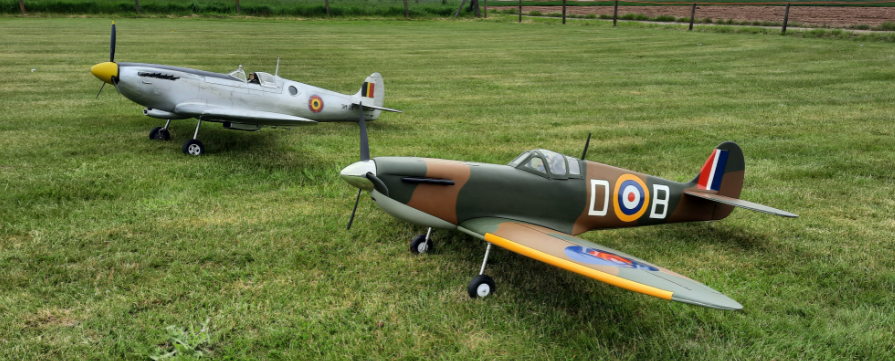
Jake B. sent over photos of his scale Spitfire, and it’s a beauty. The aircraft is sitting out on the grass, fueled up, checked over, and ready for its maiden flight. That alone is enough to get the nerves going. A maiden flight always carries that tiny soundtrack in your head: excitement, focus, and one little goblin whispering, “Did you tighten that?”
From what we can see, this Customer's build of a model RC spitfire has the right stuff. Clean lines. Great scale presence. Careful finish. The kind of stance that says, “I’m here to fly,” not “I’m here to become a balsa confetti cannon.”
And really, there’s nothing quite like a Spitfire.

The Spitfire still has the best lines in the field
Some airplanes look good from one angle. The Spitfire cheats. It looks good from every angle.
That famous elliptical wing does a lot of the work. On the full-scale Supermarine Spitfire, that wing shape helped balance performance, lift, and drag, and it became one of the most recognizable outlines in aviation. Designed in the 1930s and flown by the Royal Air Force during World War II, the Spitfire earned its place in history through combat service, speed, and agility.
For RC pilots, that shape still grabs attention. A scale Spitfire on the flightline has presence before the prop even turns. The long nose. The rounded wingtips. The tucked-in tail. The low-slung fighter posture. It’s aviation sculpture with a spinner.
A well-built Spitfire also rewards restraint. Too much added detail can turn a model into a flying museum case. Too little, and it loses the character that makes the aircraft special. Jake’s build hits that sweet spot. It looks finished, purposeful, and ready to do the one thing every warbird was born to do.
Fly.
Preferably, land too. Let’s not skip that part.

A maiden flight is where craftsmanship meets courage
A maiden flight is never “just another flight.”
It’s the first real answer to months of building, fitting, sanding, covering, painting, wiring, adjusting, and staring at the model from across the room like it owes you rent.
Before a maiden, everything matters:
Center of gravity
Control direction
Control throws
Servo movement
Linkage security
Battery placement
Fuel system or power system checks
Propeller safety
Range check
Fastener check
Trim settings
Taxi behavior, if the model allows it
That list isn’t glamorous, but it’s what keeps a maiden from becoming a crime scene investigation.
A scale warbird adds its own flavor. Many Spitfire models have narrow landing gear compared with trainers or sport planes. That can make ground handling more interesting, especially on grass. Translation: the airplane may want to dance before it flies, and not always in rhythm.
The pilot’s job is to keep the takeoff smooth. Let the tail come up. Build airspeed. Avoid yanking it off the ground too early. A Spitfire deserves a clean departure, not a panic launch with wings.
Once airborne, the first flight is about information. Not showing off. Not seeing how low it can go. Not testing every maneuver in the first 90 seconds like the airplane is auditioning for an action movie.
A good maiden flight usually focuses on:
Climbing to a safe altitude
Checking trim
Watching engine or motor performance
Testing gentle turns both ways
Checking stall behavior only if conditions and altitude allow
Setting up a calm, predictable landing
If the model comes back with all parts still attached, that’s a win. If it comes back trimmed and flying well, that’s a great day. If it greases the landing too, someone owes the pilot a burger.
Scale details make the magic work
The best scale builds don’t just copy an aircraft. They capture its feel.
That’s what stands out here. Jake’s Spitfire has the right presence on the grass. It looks like it belongs there, waiting for the call to scramble. A good model doesn’t need a runway full of props and smoke machines. Park it at the right angle in natural light, and the shape does the talking.
With Spitfires, the details that matter are easy to spot:
A clean cowl line
A well-set spinner
Smooth wing fillets
Straight panel alignment
Landing gear that sits right
A canopy that matches the aircraft’s character
Paint and markings that don’t fight the airframe
Scale RC builders know the danger zone. You can spend ten minutes fixing something nobody will notice, then spend ten hours fixing something everybody will notice from 50 feet away. The trick is knowing which is which.
The wing and tail alignment matter. So does the stance. A Spitfire that sits wrong on its gear looks off, even if the paint is perfect. A canopy that sits cleanly can make the whole aircraft look better. Tiny gaps and crooked lines jump out on a scale fighter.
That’s why this build is fun to see. It has that finished look. Not “done enough.” Done.
There’s a difference.
Sponsor kits and small shops keep this hobby moving
This Spitfire was built from one of our sponsor’s kits, and that matters.
When someone buys a kit, part, upgrade, accessory, or replacement piece from an independent RC shop, they’re buying more than a box of parts. They’re helping keep the people behind those parts in the game.
Small RC businesses do a lot of heavy lifting in this hobby.
They make the weird part you can’t find anywhere else. They answer the email about the thing that doesn’t fit quite right. They improve a design after hearing from real builders. They stock hardware that big retailers ignore. They keep older aircraft flying after the original supply dries up.
That support creates better models. It also keeps variety alive.
Without independent shops and dedicated kit makers, every flightline would get boring fast. Same shapes. Same sizes. Same predictable choices. Independent builders and sellers keep the field interesting. They give pilots projects with personality.
That’s a big deal in scale RC. The right kit can turn a lifelong favorite aircraft into something real enough to taxi out and lift off. Not a poster. Not a desktop model. A flying machine.
And yes, a flying machine that still needs a preflight check, because gravity remains undefeated. Annoyingly consistent, that gravity.
Why community builds matter
A model like this doesn’t just show off one builder’s skill. It gives the whole community a spark.
Photos from a finished build can help another modeler decide on paint. A short maiden video can help someone understand takeoff behavior. A build thread can save another builder five evenings of trial and error. Even one clear photo of a servo install can answer a question nobody wanted to ask out loud.
That’s the strength of RC Groups®. It’s not only about finished aircraft. It’s about the build path.
The sanding. The fitting. The “why is this not square?” moment. The first time the power system comes alive. The landing gear work. The covering job you redo because it looked like a raisin in a wind tunnel. The small wins pile up.
Then one day the model is on the grass, ready to go.
That’s why photos like Jake’s are worth sharing. They remind everyone that the payoff is real. A kit becomes an aircraft. A plan becomes a flight. A bench project becomes a story.
A Scale RC model Spitfire ready for the maiden flight carries a special kind of energy. It’s not fully proven yet, but it’s no longer just a build. It’s at the edge of becoming an airplane.
That moment is hard to beat.
The best maiden video is the one where the airplane comes home
Jake, if you’re reading this, send the maiden video.
No pressure. Well, maybe a little pressure. The good kind.
We want the taxi out. We want the takeoff roll. We want that first climb-out where everyone gets quiet for half a second. We want the first trim pass. We want the landing approach. We especially want the landing, because that’s where the popcorn comes out.
A good maiden video doesn’t need fancy editing. It just needs a clear view, steady filming, and enough sound to hear the engine or motor settle in. Bonus points if someone says, “That looks good,” in the background. Every flying field has that person, and they are never wrong until they are.
For anyone filming a maiden, a few simple tips help:
Stand with the sun behind the camera when possible
Keep the aircraft in frame during the takeoff roll
Zoom less than you think you need to
Film the full landing approach
Capture a few seconds after touchdown
Get a quick post-flight walkaround
The post-flight shot is underrated. That’s where the pilot breathes again, the helpers gather around, and the airplane gets the look-over. It’s half inspection, half celebration.
Also, if the landing is perfect, film the pilot pretending it was planned exactly that way.
What makes a build like this stand out
Scale aircraft reward patience. They also reveal shortcuts.
That’s why this Spitfire grabs attention. A classic fighter shape leaves very little room to hide sloppy work. The curves are famous. The wing planform is famous. The cowl and canopy lines are famous. If something is off, people spot it.
Jake’s model looks like it came together with care. That doesn’t happen by accident.
A good scale build usually shows strong habits:
Dry fit before glue
Measure twice, then measure again because the first two measurements are now suspicious
Keep the tail straight
Balance function and appearance
Plan radio gear placement early
Leave room for maintenance
Test systems before final assembly
Finish cleanly, not heavily
That last one matters. A warbird doesn’t need to be buried under detail to feel real. Clean execution wins. The eye follows the lines first. The details come after.
And with a Spitfire, the lines are the star.
Independent builders deserve the spotlight
One of the best parts of RC is seeing what people build in basements, garages, spare rooms, sheds, and on kitchen tables that someone else in the house definitely did not approve for sanding.
A finished aircraft carries all of that work with it.
Every panel line, hatch, screw, and control surface has a story behind it. Some parts went together perfectly. Some did not. Some may have required “persuasion,” which is builder language for a tool, a breath, and a quiet conversation with the airframe.
That’s why customer builds are worth celebrating. They show the hobby in motion.
Manufacturers, kit makers, sponsors, shops, pilots, builders, clubs, and online communities all play a part. The airplane on the grass is the visible part. Behind it is the full chain of people who keep RC flying fun.
So yes, support independent shops when you can. Buy the kit. Grab the parts. Recommend the maker who treated you right. Post the build. Answer the question from the next person starting the same project.
That’s how the hobby stays strong.
Thanks for sending it in, Jake
Big thanks to Jake B. for sending these photos our way. This Spitfire looks fantastic, and it’s great to see a sponsor kit turned into a field-ready aircraft with this much care.
Now we need the maiden video.
No shaky mystery dot footage from three counties away, please. Get that Spitfire in frame, let it sing, and show us how she flies.
If you’ve got a finished build, a work-in-progress project, a maiden flight, a repair story, or a favorite flying photo, share it with the RC Groups® community. We’d love to see what’s on your bench, what’s in your trailer, and what’s finally ready to leave the grass and earn its first flight.
Because a great RC airplane deserves more than one person admiring it in the garage.
It deserves a field, a first takeoff, and a crowd quietly hoping the trim clicks are small.


Comments